Showing posts with label baby led weaning. Show all posts

Sunday, September 13, 2015

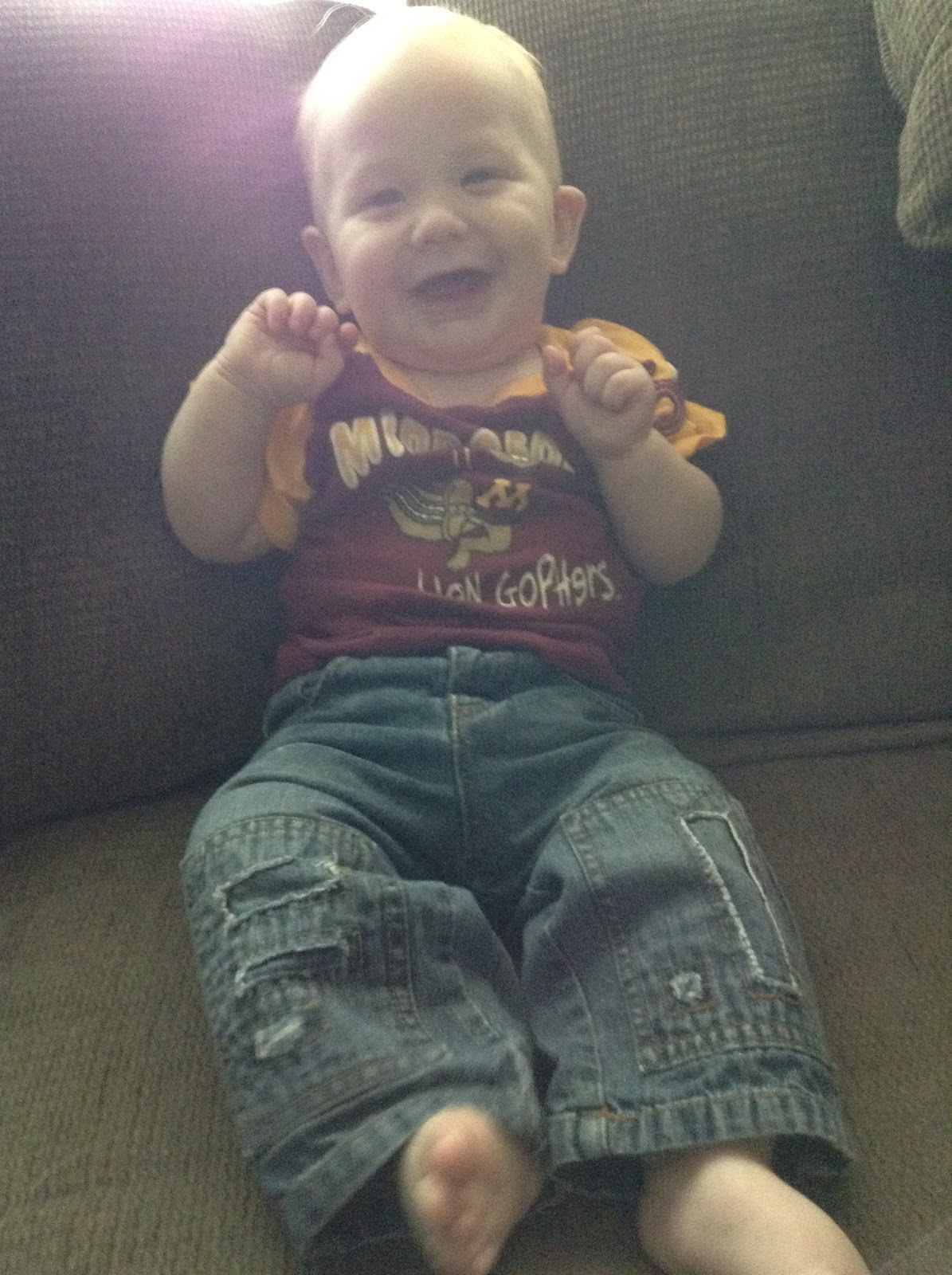
Niko at Seven Months.

What a treat for you all, two monthly blog posts for Niko in a row ;)

Getting these photos is starting to become impossible.  Outtakes below...
Niko hit seven months on Friday (9/11).  I don't have the patience to attempt to get his length on my own at home, but he's somewhere between 20 and 20.5 pounds.  He loves to smile, is getting on all fours and rocking, and so-close-but-not-quite-there to sitting up on his own.  Nothing has changed as far as he and Myra adoring each other.  I asked a friend when that might change, she said "when he starts taking her stuff," and that sounds pretty accurate.  The sibling stuff is new territory for me, just kinda wingin it.  I'm glad to have plenty of daycare/nanny experience under my belt.

We started some solids with him about a week ago.  We're starting slow, one food at a time with breaks just like we do for Myra.  We don't suspect he has FPIES, but we'll continue playing it safe until we can work our way to the top FPIES offenders.  If he does fine with those, we'll relax a lot more.  For now, we are only giving him foods she can have because feeding babies is even messier than feeding toddlers and we don't want to have to worry about her getting sick from eating his messes.  So far he has had squash and peaches, both in puree and solid (baby led weaning) form.  He approves.  Steamed sqaush seems to be his favorite.  


Niko is still waking up two times most nights, but I usually stay up until the first time (10:30ish) so he's only waking me up once and I'm generally not too tired.  He is forgiven.  He's pretty good about napping on the go if we have stuff to do in the morning.  With both kids, we keep the afternoon nap and bedtime pretty sacred.  Everyone is happier if we respect their sleep times, and we try not to mess with something if it's working!

I don't even know what else to write.  Niko is such a fun, happy, easy to please baby.  Last night we kept him out past bedtime for Trevor's unit picnic and we heard the most pitiful, hilarious cry in the car on the way home.  Neither of us could really remember the last time we had heard that.  Rather than figuring out what else to say, here are some more recent photos.


Thank goodness we have dentists in the family, poor kid is clueless


Wednesday, March 26, 2014

FPIES: Food Selection.

Part two of my last post on food trials-how we choose the foods to trial.  Myra's second safe food was coconut, and I couldn't even count how many times I've heard (and still hear), "coconut??!?" Then I attempt to briefly explain how we landed on coconut as our #2.  So, here is the not so short explanation.  (Note: we will be seeing a nutritionist/dietician soon which will be a great asset to our food selection process and Myra's medical team as a whole.)


The goals/things to consider when choosing foods for a child with such a limited diet are as follows (in kinda-sorta order of importance but it's really just a balance):

Nutrients
Calories
Risk (for FPIES in general and based specifically on Myra's history)
Versatility (in cooking options and in forms of the food itself)
Textures and appearance
Availability (seasonal vs. frozen/canned, local foods)
Safety (foods appropriate for her age and ability level)
Whole picture/end goal (work towards actual recipes, meals we can all eat together)

Now for the more detailed version of that, including how we calculate some of those factors.  Our process has been adapted from that of another FPIES mom, Jamie V., so her ideas are cited throughout this post as "(JV)."  Remember, Myra still drinks a lot of her amino acid based formula, about 20oz of a toddler formula (Neocate Junior) per day, so she is still getting most of her calories and nutrients that way for now.

Nutrients
I start by analyzing Myra's current diet, adding her most recent passed food.  I go to the Nutrition Data Website and create a recipe that includes all of Myra's safe foods (JV).  This is an average.  So, for example, if she alternates between 1 cup of blueberries and 1 cup of peaches for breakfast every other day, I would put 1/2 cup of each in the recipe since that is the average.  Once I have an average amount of all her safe foods entered into the recipe, I click "Save & Analyze."  It tells me the nutrients in which her foods are high and low, so I can see what is lacking in her diet.  Currently, Myra's diet is lower in Vitamins A, D and E, Zinc, and Calcium.  I will keep those in mind when deciding the next food to trial.

Calories
Calories are important, so we keep that in mind when choosing foods.  Many of the really nutrient rich foods (spinach, for example) are lower in calories.  Again, it's all about balance.


Risk
This is the scary part.  We want to choose foods that are likely to pass and, therefore, avoid the trauma and setback of a fail.  There is a time and a place for the riskier foods, or even challenging foods that have failed in the past, but we want Myra to have a little more variety in her diet before we pick something risky.  We need safe foods to fall back on while she recovers in the event of a fail.  If she passes a riskier food (eggs or corn), it can make life a lot easier.  Anyway, we first look at this website which shows survey results for actual FPIES children and the foods they've tried and whether they passed or failed (JV).  There is no sure thing with FPIES, but a 99% pass rate vs. a 60% pass rate makes a big difference.  The sample size is also worth noting, 50% is different if it's 1 out of 2 or 100 out of 200.  We also have to consider risk specific to Myra's history of passes and fails.  Because she failed soy, green beans, and peas (all legumes-two out of those three with severe vomiting), we will be avoiding any legumes for a while.  For example, even though red beans have a 92% pass rate, we won't be trying them anytime soon.  Similarly, I use this website to look at the food families of her current passes that will hopefully point us to other foods in those same families that will likely pass, too.  It is also available alphabetically, so I can easily look up specific foods to see their food family. 

Versatility
We look for versatility in both how the food can be used/prepared and in what forms the food is available.  This was a big part of choosing coconut.  It is available in flakes, chips, flour, oil, milk, water, and manna/cream concentrate.  As for cooking, the flour is obviously useful, oil can be used as a butter replacement, coconut milk as a dairy milk replacement (homemade ice cream!!), and the manna can also be used to replace butter and to make frosting.  What's more, coconut oil has a ton of great uses outside the kitchen, like as a skin moisturizer and soap, so we have no concerns about Myra drinking her bathwater or licking her lotion (kids love to do both...).  Did you know Burt's Bee's baby wash has soy in it?


Texture/Appearance
With a limited diet and a developing palate, we want to make sure Myra is getting a variety of textures.  Some children who are on very restricted diets end up having texture aversions and actually go to food therapy to overcome that.  When we first started solids with Myra, we followed the baby led weaning model and skipped purees.  She had so much fun with food!  When she started getting weird rashes, we took a more cautious approach and reverted back to the guidance of a new food every four days.  We're on WIC and it was easier to just use the purees we got.  Within two weeks, Myra had two repeated/projectile vomiting episodes and we eliminated all solids until we could get in to see the first allergist.  With all that lost time on Myra exploring solid foods (the saying "food before one is just for fun" was so not true for us), we noticed some issues with texture when we ultimately started solids again.  Myra would eat her pureed peaches, but would chew on then spit out any solid form.  This is how we chose potatoes.  There are many texture options for potatoes (mashed, boiled, baked, fried, chips, CheeCha Puffs-a favorite, plus flour/starch). Appearance also has a role.  We're still trying to ensure that eating is a fun experience for Myra, so having fun colors/shapes/textures on her plate (who am I kidding, we don't give her a plate...her tray) is worth something, too.

Availability
We need to make sure we can actually get the food.  Mango has a pretty high pass rate (89%), but it's not always easy to find.  We prefer fresh, but if we can find something that's available canned and especially frozen (less additives), that's a bonus.  I like to stock up on foods once it's safe for her so we always have stuff on hand she can eat, and choices for her, too (canned or frozen peaches, for example). (Some tips from JV here, too)

Safety
Myra's allergist has been very diligent about reminding me to be mindful of Myra's age/ability when giving her new foods, even foods he suggests.  So, he suggested pork, but it's my job as the parent to make sure it's prepared in a way that is safe for her to eat (choking risk, mainly).  This might be less of a concern if we had been able to continue with baby led weaning, but it is what it is.


Big Picture
Of course, the long term goal here is to get Myra on a 100% food (no formula) diet that consists of "normal" foods and recipes, ideally eat together as a family, etc.  So, things like eggs will be very helpful in preparing "normal" meals like breads, pancakes, muffins, and many other baked goods.  With her current safe foods of peaches, coconut, potatoes, and blueberries, there are only a limited number of "recipes" I can make-there are some,  just not many.  It would be nice to be able to use her safe foods to make different meals for her, not just the same individual food items day after day.  Luckily, she doesn't mind so far, but that's the long term goal.  She will be on formula for quite a while, but the more calories/nutrients she can get from foods, the less formula she will need.

Miscellaneous
And, of course, there are other little things to consider like: if this food is available canned, is that version safe (so many packaged food items have the most bizarre things added, like most canned peaches contain pear juice and other ingredients-look at your labels sometime), is it messy (blueberries stain, but she loves them so oh well), is it available in freeze dried form (Myra loves those and they're less messy!), does it make a good finger food (motor skills-babies/kids learn a LOT more than how to satisfy hunger by eating), is it easy to eat on the go (we like to do things and have to bring her food everywhere we go), etc.  I probably never stop thinking about food, but luckily it must be mostly subconscious by now so I can actually accomplish other things.

Now that you know our process, here is the quick version of how we chose Myra's first few food trials:
Peaches: After we switched Myra to formula, she immediately began struggling with constipation.  She had previously had peaches, they have a high pass rate, and help prevent constipation-perfect.
Coconut: Already explained, but mostly for the variety of forms (milk, flour, oil, manna, flakes, etc.) plus the actual nutrients/healthy calories.
Potatoes: At this point we were getting more concerned about texture issues since she was still refusing any solid form of peaches and only eating the purees.  So, texture variety and ability to mix other foods into mashed potatoes in the future won.
Blueberries: Myra's allergist suggested a berry, they're a good finger food, available frozen.
Spinach: This one hopefully passed, but we had some really goofy night's sleep during the trial, so we finished the two weeks but put it on the back burner for now and we'll revisit it sometime.  Anyway, we chose it because of its nutrients and high pass rate (obviously not for its calorie content!).
Pork: Myra's allergist suggested this as a high pass rate protein (86%).  Trevor comes from a hog farm family (availability!!) and it comes in many forms (bacon, chops, ground, bacon, ham, steak, bacon...).  Meat broth is often used to add flavor/calories to recipes and to promote gut healing after a fail/illness.  This even gives us a gelatin we can use.  We're not wasting any part of the pigs, here!
Cocoa: I wanted to be able to make my kiddo treats.  Cocoa can be used to flavor things and I have found two brands of chocolate that are only cocoa and sugar (Enjoy Life and Amanda's Own).  So far, she doesn't love it (I don't like chocolate), but it's an option now!

Note: We have since met with a dietician who backed up our process and provided guidance on nutrition goals, toddler serving sizes, nutrients, etc.  Although we have a great system for figuring this out on our own, meeting with her is an important part of food selection for us.

I am 90% sure this is in my head and not intended, but I have sometimes felt questioned about how we pick foods for Myra.  So, yeah, no need for that-it's alllllll under control.  Like, totally 100% under control.

A big thank you to my fellow FPIES parents, Myra's allergist, and resources like IAFFPE and The FPIES Foundation for all the information and support we have received!  We would not be making such educated decisions without that wealth of knowledge and experience.

Click here for more details about Myra's foods and other FPIES posts
Click here for the post about our journey to Myra's diagnosis

Friday, January 31, 2014

Failure is Progress (FPIES and beyond).

Somehow, eventually, if one looks hard enough, there is always a positive in every negative.  It may not seem so right away and it may not seem like the positive is worth the negative, but it's there.

I've met some wonderful parents, mostly mamas, on Myra's (our?) FPIES journey.  They've helped me come to some relieving conclusions during some low moments.  Also, hindsight is our friend.

So far, Myra's safe foods are Neocate Infant formula, peaches, coconut, and potatoes.  She has also done fine with cane sugar, salt, baking soda, cream of tartar, and citric acid.  Her suspected fails (likely fails in hindsight, but not officially trialed since her FPIES diagnosis) are soy, green beans and possibly some grains (wheat and oats). Her known fails are dairy, green beans, sweet potatoes...enter carrots.

After a couple vomiting episodes back in September, I brought Myra to her doctor and he referred us to an allergist.  Based on the vomiting after new foods and some indicators on her blood work, we both suspected food allergies.  There was a five week wait for the allergist, so while we waited, we changed our approach to solid foods and I continued to nurse (my only dietary restriction at that time being dairy as we thought she just had a dairy sensitivity).  We stopped baby led weaning and went to a much more structured four day trial for new foods.  If she didn't vomit, get hives/rashes, we called it good after day four.  She seemingly passed peaches, pears, carrots, sweet potatoes, turkey, and pineapple.  Coincidentally, she started waking more at night (five times most nights) and screaming plus refusing naps.  This was very similar to what we experienced in her early months that led to me eliminating dairy.  We didn't make any connection to the night wakings/drama because those foods are some of the least likely for IgE (traditional) food allergies.  We kept on with those foods and figured the night stuff was a phase, a developmental thing, a sleep regression, anything but food related.  The allergist appointment was mid-October and that was our first time hearing of FPIES.  Upon doing some research and connecting with FPIES families, it turns out many of the most common safe foods for "allergic babies" are the most common triggers for FPIES babies (sweet potatoes, green beans, rice and grains).  Most of this is in the post about Myra's FPIES journey, but bear with me I'm getting to my point.  When we started over with food trials after Myra's FPIES diagnosis, we chose sweet potatoes first.  It was risky since it's a common FPIES trigger, but she had had it already so we gave it a shot.  I knew the first night it was a fail, but we pushed through for three more days to be sure.  Neither Trevor nor I wanted to dismiss a food because of one bad night. 

Our sweet potato fail was very discouraging.  I had a mini meltdown about it.  We finally get a diagnosis, plan longer food trials, choose a food after being completely off solid foods for over a month, and fail.  Thanks to a fellow FPIES mama, I was able to bounce back and realize that failure is still progress.  We need failures to know what we have to absolutely avoid and with which food groups to be extra cautious (i.e. legumes or grains).  Failing a food trial also helps us see what her fail patterns look like.  Some FPIES babies don't show any signs of a fail until their 10th exposure, or until they take a break from a food then come back to it.  Some have very unique fail symptoms, or little mini symptoms that appear before the big, scary ones.  This failure wasn't a total loss.  It was progress.

At that point, we decided to get her on an amino acid based formula (Neocate Infant) to get her system to some sort of a baseline.  We gave it a couple weeks and she improved.  We chose peaches (to help with constipation thanks to the formula), then coconut (to give us healthy fats and versatility: flour, oil, manna, flakes, chips), then potatoes (to give us versatility with cooking and textures).  We chose carrots next because we wanted a vegetable that would help with constipation and we were optimistic since she had already had it.  We hoped all the craziness of September could solely be attributed to the sweet potatoes (and soy in my diet). 

We gave Myra one bite of pureed carrots at 8:00am.  She was seemingly fine all day, although her afternoon nap was pretty short.  She has been a bit stuffed up which makes drinking out of a bottle more difficult, but for the most part she drank her formula well and ate quite a bit of potatoes and peaches throughout the day.  She went to bed at 7:00 pm like usual, fell asleep right away.  She woke up (but didn't even really seem awake) at 7:30 pm whining which turned into moaning.  I gave her about 10 minutes (while I panicked and went to dramatic paranoid FPIES mom mode) and she went back to sleep.  Phew! Dodged a bullet there, right? Nope.  She woke up at 8:30 pm and did the same thing, but for longer.  I went to her, suctioned her nose (clear), and started rocking her.  She stood up in my lap, poked at my cheeks, showed me her doll, waved and said "hi! hi!"  I tried to get her to relax, but she was just wired, so I put her back in her crib.  She was quiet for about 10 minutes, then the whining and moaning started again.  Trevor came upstairs and asked if she had been like this all along and I explained what had been happening.  We both knew it was a different moan.  It's awful.  It's the sound I would expect to hear from someone who has stabbed and left for dead.  I made myself a bed on the couch, went to get her and tried to sleep with her there.  She just wanted to play, talk, jump.  Some of you may think, "she must not really be in that much pain if she snaps out of it that easily!" Wrong.  My conclusion is that she's bothered so much, she can't relax and go back to sleep.  Once we can somehow get her situated and back asleep, she will stay asleep for a few hours.  Then we start over when she wakes again.  (She slept through the night, 12 hours straight, the previous three nights.)  Back before we had a clue what was happening (dairy issues in the early months) she was very easily consoled.  No one seemed to believe something was wrong because she would quiet down and go back to sleep if I just rubbed her belly.  When it's teeth, constipation pain, or illness, she doesn't turn into playful Myra and rocking back to sleep works right away.  This is her [chronic] fail pattern.  This is progress.

Now, the timing of the fail (ingestion to fail symptoms) may not be the exact same every time.  Since she has already had carrots (and sweet potatoes), I'm not surprised we noticed the chronic fail (sleepless nights, abdomen pain, but no vomiting or diarrhea) on day one.  For a completely new food, it may take a few days or even a break then reintroduction to see these signs, but we know better what it looks like.

FPIES aside, can't this same idea be applied to most failures in life?  Failed relationships help us realize what we really want and what doesn't work.  Failed classes help us narrow our scope and find our strengths and passions.  Failed attempts at fixing things around the house teach us what doesn't work.  Failed planning (events, work stuff, budgeting) shows us what we need to do differently next time.  Failed cooking encourages us to hone our skills in the kitchen.  "Failed" medical tests tell us what needs treatment.  Failure isn't a total loss.  Failure is progress.


PS-don't roll your eyes at me just yet.  It's not all rainbows and unicorns over here.  Want to know my fail pattern?  Exhausted, lazy, crabby, coffee, poor food choices, coffee (yep, twice!), neglecting house work, and spending my entire day trying to nap.  Thankfully it doesn't last long.

Friday, November 22, 2013

Myra's Diagnosis: Food Protein Induced Enterocolitis Syndrome (FPIES).

Some of you may know, some may not, that Myra has been struggling with some food-related issues. For your reading pleasure, I've divided this into a few parts: the history/symptom part, the diagnosis part, and the "what the heck is FPIES" and "how do you deal with it" parts. Many of you are already familiar with one or more pieces of this puzzle, so I'm trying to avoid boring you with redundancy. (Note: anything that is a link will take you to a site with more explanation/information since not all of these terms are self explanatory. For up to date information on Myra's food trials, safe foods, recipes, etc. click the "Myra's FPIES Foods" tab at the top of the page.)


The history:
Sleep in the early months was non-existent, and not the "I just had a baby and I'm exhausted" kind of non-existent. It was the no sleep, or maybe two 30 minute spurts a night for weeks on end, kind of non-existent.  She was happy during awake times, but when she was supposed to be sleeping she would always (ALWAYS) wake up 30-40 minutes later obviously in pain (a specific whiny cry, curling up as if her tummy hurt). Over and over. I could put her down "drowsy but awake" or, if she fell asleep in my arms, I could put her down and she wouldn't wake up right away.  She sucks her thumb so she wasn't waking for a pacifier. I was miserable and seeing the world, and my new baby, through awful, sleep deprived glasses. I didn't like my new baby (until I'd get a couple hours of sleep, then I was quite smitten).  The baby we waited SO long to have.  Then I felt guilty for having all these awful feelings, and so on and so on.  I took quizzes to make sure it wasn't postpartum depression.  Nope, I was just so. freaking. tired.  Don't get me wrong, it was certainly not easy on Trevor either, but I did my best to let him get sleep (very interrupted sleep, I'm sure) so he could be alert for his commute and school. And, of course, this affected us both in ways beyond the sleep deprivation.  After trying everything else (ok, except co-sleeping, but that's just not for us) and seeing Myra's doctor and a pediatrician who both said she seemed perfectly healthy, I decided to eliminate dairy from my diet (Myra is exclusively breastfed) even though Myra didn't show the "typical" symptoms of a dairy sensitivity. After three weeks (how long it takes for cow's milk proteins to work out of my system then Myra's), she was a different baby. She started sleeping 12 hours straight, no wake-ups, for six weeks!  I was really hoping it was a coincidence, so we tested dairy twice by giving her milk I had pumped before changing my diet. Bad idea, that confirmed it. No dairy!


(Believe it or not, this is the somewhat shortened version...) 

After those six weeks and a dairy exposure, she started waking at night again. The couple rough nights following the dairy exposure passed, but her sleep didn't return to how it had been. We thought maybe a growth spurt... teeth... milestone... then we started solids so maybe that. Finally we came back to "something is wrong...again." We had taken a casual approach with introducing solids (other than avoiding dairy), using baby led weaning and not following any specific timeline for each new food. Everything seemed fine, she was eating a variety of healthy foods, enjoying it, and we didn't really connect the dots with the night wakings and other more subtle symptoms creeping back in...yet. Early September we gave her a couple graham cracker sticks. After a few hours (3-4) she started vomiting. She threw up six times in two hours until she had thrown up bile and was ultimately dry heaving. She was, of course, exhausted afterwards and it was also bedtime. I got her to nurse a bit and put her to bed. She seemed fine the rest of that night and the next day. We figured it was either a coincidence or the graham cracker and we were hoping for coincidence.  Skip ahead through some rashes, sleepless nights, and swelling episodes and we figured she had some "traditional" (or IgE mediated) food allergies, so we took a step back and started over with 4 day food trials. I took her back to her doctor who did a blood panel which indicated she may have some allergies, and referred us to an allergist. We couldn't get in for that for 5 weeks, so we just kept plugging away. Things went okay, meanwhile her chronic symptoms started coming back (more on that below), but she did have three other vomiting episodes. None of those were quite as "bad" as the graham cracker, but once was from green beans. Seriously?! Green beans! 


These are the chronic symptoms we noticed starting in August and really intensifying in September:
Sleep disturbance (understatement of the year).
Big, loud farts that smelled horrible, like sulfur.
Constant diaper rash.  Constant.  Mostly only where her poop had contact.
Back arching at night time feedings.
Head banging (in her crib, sometimes elsewhere).
Body tensing/stiffening and clenching fists until trembling.
Coughing in her crib.
Lymph nodes behind ears always swollen.
A few levels from complete blood count increased in April and September (when I brought her in for these issues and she wasn't sick with anything else), specifically platelet count.
Rash on the rest of her body, little dots, mostly on her torso and neck.
Who the heck knows what normal poops look like after all this, but hers were definitely not normal at times.
Crying and tensing with diaper changes.
Little, juicy burps when I would pick her up out of her crib.
Despite all that, a very happy baby! (Except at night/sleep times sometimes)
Each of those things in themselves could be considered a normal baby thing, but combined, they paint a picture of something else happening.


The diagnosis:
When our allergist appointment finally arrived, we went through the symptoms, timelines, etc. with him and discussed allergy testing options and he brought up FPIES (Food Protein Induced Enterocolitis Syndrome). Since her reactions were not immediately following ingestion and didn't involve respiratory problems, he seemed to be leaning more towards FPIES than traditional allergies. FPIES is a non-IgE mediated food allergy, so if that were the case, she would not test positive on allergy testing (although it is possible to have both). We decided to do skin prick testing for dairy, wheat, and soy and they were all negative. We then did blood testing for the same three things, also negative. He wanted to consult a colleague who had more experience with FPIES and get back to us. Meanwhile, Myra's chronic symptoms had gotten so intense I decided to try eliminating soy from my diet and we took her off all solids until we could figure this out. Both the allergist and Myra's doctor were aware of these dietary changes. .....Three weeks (and two emails from Myra's primary doctor) later, we heard back from the allergist we saw. He spoke with his colleague and she "did think it could definitely be FPIES." We were to avoid feeding Myra dairy, soy, oats, wheat, and rice. That's it. (Remember, she vomited after eating green beans and that wasn't even included in her no-no list...) Thankfully, we had already decided to move forward with other options and made an appointment with an allergist in Minneapolis who has experience with FPIES, Dr. Stillerman. He's actually listed on the FPIES Foundation's website. Also, Myra's doctor gave us a referral to a pediatric GI specialist, Dr. Grothe, to rule out any other GI problems (and/or confirm FPIES). 


When Myra and I met with Dr. Stillerman (allergist with FPIES experience), we almost exclusively discussed her acute symptoms (vomiting mostly), and only touched on her chronic symptoms. He agreed with the two allergists that it, indeed, did sound like FPIES. He sent a letter (below) to her primary care doctor and also gave us a copy to keep with her at all times (more on that later). We discussed a plan for reintroducing solids and discussed different formula options since Myra seems to react to things through my breast milk. To be clear, Dr. Stillerman did not suggest I stop nursing. (Also, to be clear, I have breast fed Myra exclusively for 10 months now, but I have absolutely no issue with people using formula no matter what the reason.  Science is a wonderful thing, too.) "Normal" formula most often has either a dairy or soy base, and contains the full protein chains as-is. Some more sensitive formulas (Nutramigen or Alimentum, for example) have partially broken down those protein chains to make them easier to digest. Elemental formulas (like Neocate or Elecare) have completely broken down the protein chains into individual amino acids.  Since FPIES has to do with food proteins, the elemental formulas are the safest bet when choosing a formula. There are certainly babies who do well on others depending on how sensitive they are and what triggers they have. Cost is most certainly a factor in determining which to try.  Together, we developed a plan for starting solids again as well as an emergency plan if Myra reacts to a food.


A few days later was our appointment with Dr. Grothe, a pediatric GI specialist. We thoroughly reviewed Myra's symptoms, both acute and chronic, beginning with the sleep disturbance and dairy elimination from early on. She explained that if there were some sort of anatomical GI issue (reflux, a twist in her intestines, etc.), Myra's symptoms wouldn't change so drastically based on diet, touché. Based on Myra's history, Dr. Grothe agreed with the diagnosis of FPIES and stated she would document it as such in Myra's chart. It may sound strange, but I can't describe the relief I felt hearing she would have an "official" documented diagnosis!  Dr. Grothe was supportive of the plan we had in place as well as the switch to an elemental formula. (By now we had decided we would gradually do the switch after our first food trial which we had already started. Formula will need to be a trial in itself.) She made sure we had access to Mayo's patient portal so we could easily contact her if anything changed.

Note on the formula: while I don't care how others feed their babies, I do understand that it is a very personal decision for many families.  There are moms who have found a way to work around FPIES, even with triggers through breast milk, and continue to nurse.  This is possible for us, but after weighing all the pros and cons, we have decided to trial a switch to formula and really hope it goes well.  Breastfeeding was hard at first, but it has become so easy.  I have found many ways to still eat the foods I like with substitutions when necessary, but the change does come with stress.  Considering the emotional toll as well as the effort it takes to get enough calories for a nursing mom each day, formula is the right decision for us right now.  That doesn't mean it will work and that doesn't mean it's the right decision for everyone, FPIES or not.  This can be a very hot topic in the parenting world (which blows my mind), so I thought I would just share our logic on the issue.  Do your homework then make your own decisions for your own family, adjust as needed-best parenting advice I've ever read!

Update: We did switch to Neocate Infant formula and Myra has done absolutely wonderful on it.  I continued to pump for a couple weeks in case it didn't work out, but that in itself was so exhausting (mentally and physically) it didn't last long.  Since there are no proteins in the amino acid based formulas and FPIES is a protein disorder, the chances of a reaction would be rare.  If she did react, we were prepared to find alternatives, but at that point continuing to breastfeed was not one of our options.  We noticed improvement within those first couple weeks and she continued to sleep better and show less and less of her chronic symptoms as time went on.  As of early February 2014, Myra has 4 safe foods.  I will keep a current list of her foods on the FPIES tab at the top of the blog page.  I do sometimes question if maybe we're just over reacting or reading into stuff so much, but looking back at how awful our nights were, the vomiting, screaming, zero sleep compared to now, it's night and day difference.  I have a hard time saying she's such a different baby because she was, somehow, still so happy all the time, but the sleep and other symptoms were absolutely present.  There is none of that now unless she is in a food trial that is not going well.  The big difference there is we know the cause and can stop it much sooner, even if it means stopping the problem food and waiting a day or two, that's a huge difference from months ago when we didn't attribute it to food at all.


What is FPIES:
FPIES, said F-Pies, stands for Food Protein Induced Enterocolitis Syndrome. It is a type of food allergy, but different from traditional food allergies. I'm not going to reinvent the wheel here. This letter is taken from the IAFFPE website and it is the same letter Dr. Stillerman personalized and sent to Myra's doctor. We also have to keep a copy with Myra in case of an emergency.
Myra has a food allergy called Food Protein-Induced Enterocolitis Syndrome (FPIES). This is a type of allergy that usually does not result in typical “allergic” symptoms such as hives or wheezing, but rather isolated gastrointestinal symptoms. The symptoms of this type of allergic reaction include repetitive vomiting that may not start for a few hours (e.g., two hours) following ingestion of the food to which the child is allergic. Even trace amounts can trigger a reaction. There is often diarrhea that starts later (after 6 hours). In some cases (~20%), the reaction includes hypotension and lethargy. The treatment is symptomatic and can include intravenous fluids (e.g., normal saline bolus, hydration) and steroids (e.g., Solumedrol 1-2 mg/kg) for significant symptoms. The latter is given because the pathophysiology is that of a T-cell response. This information is being given so that this could be considered in the differential diagnosis for this patient in event of symptoms. Of course, this illness does not preclude the possibility of other illness (e.g., infection) or even other types of allergic reactions leading to symptoms, so it is up to the evaluating physician to consider all possibilities. Similarly, the treating physician is encouraged to pursue any other treatments deemed necessary (e.g., symptomatic such as epinephrine for shock, antibiotics for presumed infections, etc.)


What do we do about it:
There is no cure or treatment for FPIES. It's unknown what even causes it. Management involves very cautious, precise food trials (two weeks per new food, every single thing-even things as simple as sugar or cinnamon), identifying safe foods and avoiding trigger foods.  Even the smallest amount can cause a reaction and reactions can be very severe (some vomit to shock). Many children outgrow it. There seems to be a fair number who outgrow at least some triggers by age three, more by age eight, and some who don't outgrow it at all. There is no way to know except food trials and, when deemed appropriate, challenging trigger foods, sometimes in a clinic or hospital. Dr. Stillerman really stressed the importance of calling for an ambulance if Myra starts vomiting since we don't really know how bad her reactions might be and we can't give her the care she needs while driving.  For food trials, we will likely only give her the new food for breakfast and/or lunch so we can monitor her since the reactions are delayed. Once she "passes" a food, we will include it in her diet for any meal. With this first trial, I only gave her a few bites in the morning for the first two days then increased the amount on the third day. If she vomits or has diarrhea, we will call it a fail and consider it a trigger food. If she shows some chronic type symptoms, we will give it a few days to make sure it isn't a coincidence before considering it a failure. We're keeping a detailed journal with times foods are given, sleep patterns, poopy diapers, and other relevant symptoms during trials. Hopefully, after a few trials, we can make sense of patterns so we can pick up on failures early. Or, better yet, hopefully she doesn't have many triggers and this all goes smoothly! For solids, we are starting with foods she has already had and to which she didn't seem to have major reactions. Often trigger foods are found after the child has had a break from it, so many people actually build a 2-3 day break into their trials. So, hopefully, we'll notice sooner than later if something isn't going well with these first few foods. If you've made it this far, you'll be glad to know you're part of the plan, too! Educating others, especially people who will be around Myra, is a HUGE part of our plan. People need to know how serious this can be, even from a very small amount of a trigger food. Myra can't have anything other than her safe foods (of which she has none right now) because we need to be in complete control of her food trials. If she gets her hands on a trigger food (or even an unknown food/substance) during a trial of something else, it will completely negate any progress in that trial, not to mention make her (and us) miserable. This isn't some paranoid, silly, new parent thing-it's very real and it's become a big part of our lives. We have to be careful even in our own home. Trevor washes his hands after eating and before touching Myra (I don't eat Myra's known triggers since I am still breast feeding, but I'm still careful, too!). We have to vacuum often so Myra doesn't eat leaves, clumps of dog hair, etc. (believe me, she tries!). We can't risk anything getting into her system because we have no idea if it would affect her. Of course, I'm human and wonder about things like "what kind of ingredients can we include in some sort of a birthday cake two months from now" and "will she feel left out at meal times," but those things will sort themselves out in time, so I just try not to get ahead of myself.  I've already heard a lot of "I could never do all of that," and similar statements. Just like military life (although that's more so a choice than this), you just do it. We play the cards we're dealt. It's not always easy, but it's not like Myra is naughty or a burden. She's a beautiful, happy, smart little girl with a big personality. And I never thought I would feel such joy being able to feed my baby FOOD, but since getting an actual diagnosis and starting solids again, feeding her feels so GOOD! Bonus--similar to military life, I've already met some totally awesome FPIES parents. They're full of information and experience, they ask what's going on and truly listen, remember when our appointments are and ask how they went, and offer excellent advice and support. Some have given us tips for working with our insurance company, navigating various clinics, etc. In some ways, yes this kind of takes over life some days, in other ways, it is what it is but it's just how we have to do food. With the right understanding from friends and family, it doesn't have to be a big deal.  The food trials and journaling probably sound intense, but that part really isn't so bad so far.  The biggest hurdle will be failures.  We haven't had a vomit to shock episode, and I pray that never happens, but let me tell you these chronic symptoms are HORRID.  Things could always be worse, it's all about perspective, but when you're on your eighth night in a row of a baby who screams no matter what you do and has a diaper rash so bad she scratches herself until she bleeds, you're not really thinking about "perspective."  

Truthfully, I could go on and on about the emotional toll this has taken, at times, on all of us.  Again, if you've made it this far, I imagine you can guess.  I'm not a label person, but this official diagnosis (and game plan) has already lifted weight off our shoulders.  Hopefully it will help others (medical professionals included) understand how serious this can be.  It will help us get the very expensive formula (that hopefully she tolerates) costs covered.  And, yes, it's validating that we're not crazy or dramatic or anything like that.  FPIES is a real thing and Myra has it, a real explanation for all these symptoms.  And if she ends up in daycare or still has it when she goes to school, an official diagnosis will likely be very helpful in those settings to ensure proper precautions are taken.

Please remember there is not a whole lot of "science" behind this, it's mostly observation.  The diagnosis is clinical based on medical history.  The symptoms and severity can vary greatly by food and baby.  While this may be helpful if you're running into some of the same issues, please don't use it as a replacement for working with your health care team.  It took bringing Myra in many times until the pieces of the puzzle started to make sense.  Blood work twice for no real reason, just to see if anything stood out.  And a lot of documentation on my part.  

Now, I'm off to relax and hopefully get a good night's sleep!  As always, any questions about this or anything else on the blog, PLEASE just ask.  I'm an open book.

 This was taken before we suspected any food issues beyond a dairy "sensitivity," but still an adorable food-related photo :)

Thursday, August 29, 2013

7 months old.

Myra hit 7 months last week. She's growing so fast and her own personality is showing more and more. We lucked out with such a happy baby!!  

She's sitting completely unassisted, getting up on all 4's and rocking (crawling soon??), babbling lots (and doing a face her dad used to do, "possessed" - last photo of this post), and smiling all the time. We started her on solid foods a la baby led weaning a couple weeks ago and so far she's had carrots (steamed), bananas, avocado, toast, cucumber, kiwi, mango, mandarin oranges... I think that's it. Cucumbers are her favorite and carrots are a close second. Avocado was a big hit but anything mushy sticks to her and makes her eczema flare up, poor girl. 

Myra had been sleeping through the night (11-12 hours straight, no wake ups) for about 6 weeks, maybe even longer, but has recently been waking up once or twice to nurse (I assume). She goes right back to sleep and naps well (unless interrupted by poop...) so we're just going with it. 

Myra and Rowdy are becoming good buds! She reaches for him to pet/scratch him whenever she can, sneaks him her carrots and tries to steal (and gnaw on) his toys. Rowdy parks it right by Myra quite a bit. I'm sure once she can crawl, and especially walk, they'll be even better friends.

No teeth yet! I keep checking, but still nothing. We're still doing great with breastfeeding and I see no reason we won't make it to at least a year. It wasn't easy at first, but I'm glad I was so stubborn.  We've found a love for babywearing which allows me (or Trevor) to snuggle Myra while walking Rowdy, cleaning, cooking, shopping, etc. 

I'm sure I'm forgetting stuff, but I think I but all the big milestones. Here are some photos:


Related Posts Plugin for WordPress, Blogger...